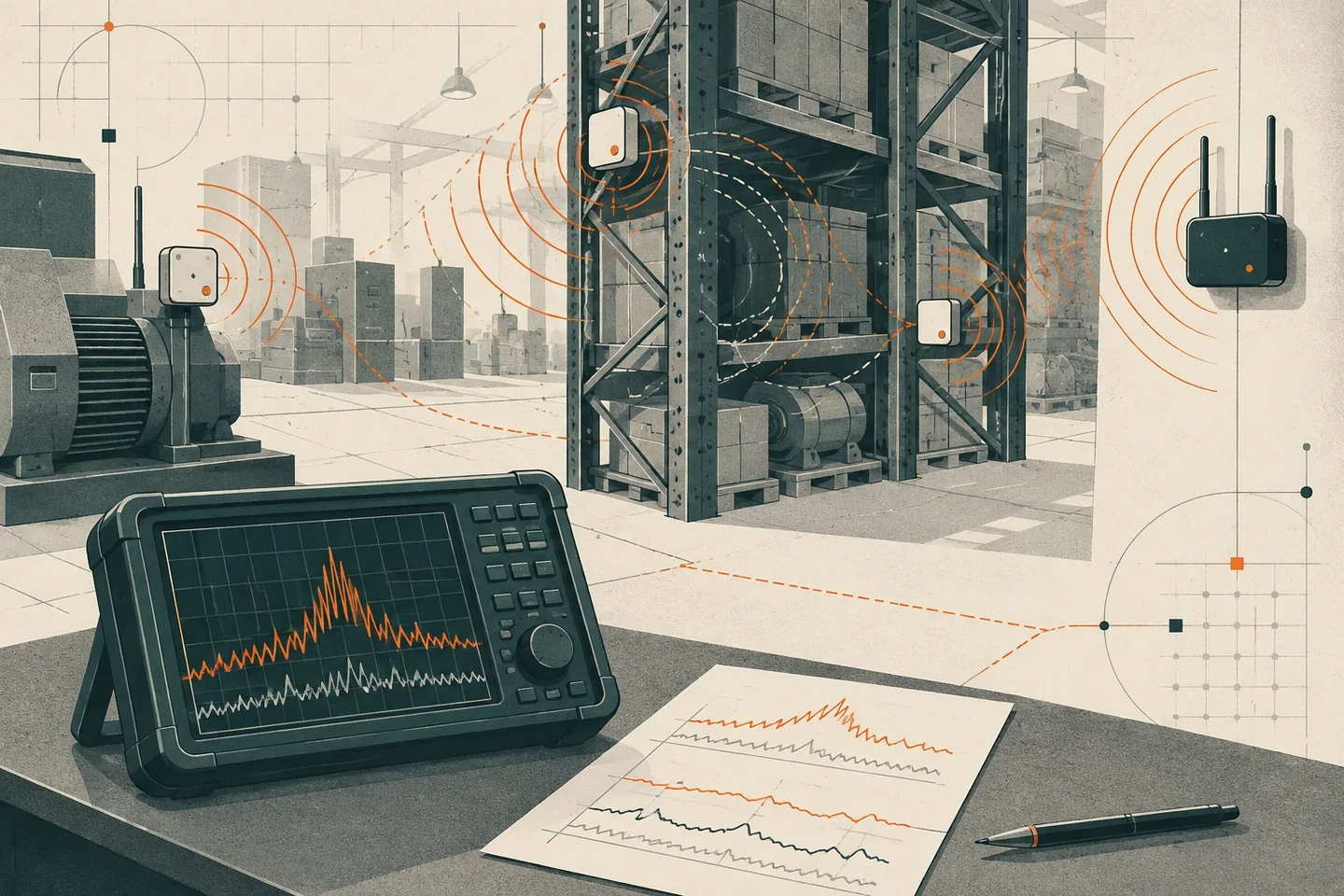
A scanner stalls in one aisle, a sensor reports late, or a mobile terminal disconnects during a shift. “Interference” is still a hypothesis: a weak radio path, competing transmissions and a failing endpoint can look similar to the user.
Preserve the failure conditions before changing a channel or increasing transmit power. Record what happened, where and when, and which devices were involved. The first hour should narrow the fault and produce a testable next action, even if it cannot identify a source.
Freeze the scene before adjusting the network
Record the local time and duration of each failure. Note the production area, device position and height, route, nearby machinery, and any door, vehicle or stock load moving through the radio path. Identify the endpoint, access point or gateway, band and channel where available, and the failed application transaction. “Scanner A lost its inventory confirmation beside rack 4 as a forklift crossed the aisle” gives the team something to reproduce.
Compare another device in that location and the affected device elsewhere. Check wired users and other services. Save controller, gateway, endpoint and application logs with their time zones; record clock offsets before aligning events. A signal indicator cannot establish why an application timed out.
Keep the original configuration and note recent access point maintenance, firmware, antenna work, new equipment, shelving or devices. Change one setting at a time; otherwise, an improvement cannot be attributed to a particular change.
Separate four plausible fault paths
Path loss and obstruction. A useful signal can weaken with distance or change sharply when metal structures, machinery or moving stock alter the path. Check measurements at the endpoint’s working height and along its actual route, including the return path from endpoint to infrastructure. NIST measured path loss and delay spread across three different industrial facilities, illustrating why a site’s own RF baseline matters more than a generic range estimate. Its radio propagation study provides the measurement context; it does not supply a universal threshold for every plant.
Co-channel activity. Other devices using the same or overlapping spectrum may contend with the affected link. Compare channel use, retries and performance during the reported window with a quiet period and with nearby unaffected links. Identify the technologies present before interpreting a busy-channel reading. NIST’s ISA100.11a testbed study examined the effect of existing Wi-Fi activity on an industrial sensor network. It supports checking coexistence where systems share a band, but the testbed result does not diagnose an individual site.
Non-Wi-Fi RF activity. A Wi-Fi management screen describes what its radios can observe and decode; it is not a complete inventory of emissions in the band. If failures coincide with a machine cycle or occur while Wi-Fi traffic appears ordinary, arrange a spectrum observation with suitable equipment and a person qualified to interpret it. Record frequency, bandwidth, timing and measurement position. NIST describes spectrum monitoring as a way to find incompatible spectrum use and sources of harmful interference in industrial environments. Its monitoring requirements report also makes clear why the observation must be tied to the facility’s operating conditions.
Endpoint or downstream fault. A damaged antenna, low battery, device software problem, authentication failure, gateway outage or slow application can produce a “wireless” complaint. Compare a known working endpoint on the same route and the suspect endpoint in a known working location. Trace a failed transaction beyond the radio link. If the radio remains associated and frames are delivered while the application waits, the investigation must follow the transaction rather than continue changing RF settings.
Interpret counters alongside the task. A strong received signal does not rule out competing transmissions, and a busy channel does not identify the transmitter responsible for a failed transaction. Note whether retries rise only at the failing position, across several nearby links, or when a particular machine operates. Repeat the observation during a working period with the same device and workload. If those conditions cannot be matched, record the difference rather than treating two readings as a controlled comparison.
Run a first-hour field sequence
- Confirm the operational impact. Identify the affected task and its safe fallback with the process owner. If missed messages could affect a controlled process, follow the site’s operating procedure before attempting a live test.
- Define the failure boundary. List affected devices, locations, shifts and applications. Check whether the fault follows a device, a place, a time window or a particular transaction.
- Capture a baseline. At the failing point and a nearby working point, record the same available measures: received signal, connection state, retries or packet delivery, channel activity, and application completion. Note the production conditions for each reading.
- Observe the spectrum when indicated. If the pattern suggests competing RF activity, capture a time-stamped observation during both the failure and a comparable working period. Include the observer’s position and instrument settings.
- Make one controlled change. Choose a reversible action that tests a specific explanation, such as moving a test endpoint clear of an obstruction or trying an approved alternate channel during a maintenance window. Record who authorized it and how to restore the baseline.
- Retest the same task. Repeat the route or transaction under comparable load. Check for improvement in the application result as well as the radio measures, then restore or retain the change according to the evidence and site procedure.
Use a worksheet that preserves the comparison
A short escalation worksheet prevents useful field observations from turning into an unsupported conclusion. Give the incident one identifier and keep every reading under it. The minimum record is:
- Baseline: time and time zone; location and device height; endpoint and infrastructure identifiers; band and channel; software or configuration version; workload; production state; symptom; and available radio and application measures.
- Spectrum observation: instrument, settings and position; observation interval; emissions or channel activity seen; relationship to the failure window; and limits of what the instrument could identify.
- Controlled change: the hypothesis, exact single change, approval where required, start and end times, rollback setting, and any other condition that changed unexpectedly.
- Retest: the same transaction or route, comparable operating conditions, repeated results, remaining failures and the next question if the evidence is inconclusive.
For example, a handheld app may show a crowded channel at the moment a scanner stalls. That observation warrants a closer look; it does not prove which transmitter caused the stall. A spectrum trace may establish that energy appeared in the band, but attribution still needs timing, location and a controlled comparison. Likewise, a better signal reading after a device is moved does not show that interference was absent. State what each tool observed and what remains an inference.
Escalate with a question, not a label
Send the network or RF specialist the worksheet, raw logs and a precise unresolved question: “Does the burst recorded beside rack 4 align with the scanner retries, and is it present when the machine is idle?” That is more useful than “find the interference.” Include the failed tests as well as the successful ones. A hypothesis that survives only because contrary readings were omitted is likely to waste the next visit.
Close the incident with the affected devices and route, reproduced conditions, tested change, application result and untested areas. If the source remains unidentified, say so. The recorded comparison should explain whether the change deserves to stay and what to measure next.